The Digital Product Passport (DPP) is set to transform how product information is collected, shared and used across European value chains, creating new requirements and opportunities for businesses in the areas of transparency, digital traceability, sustainability and circularity.
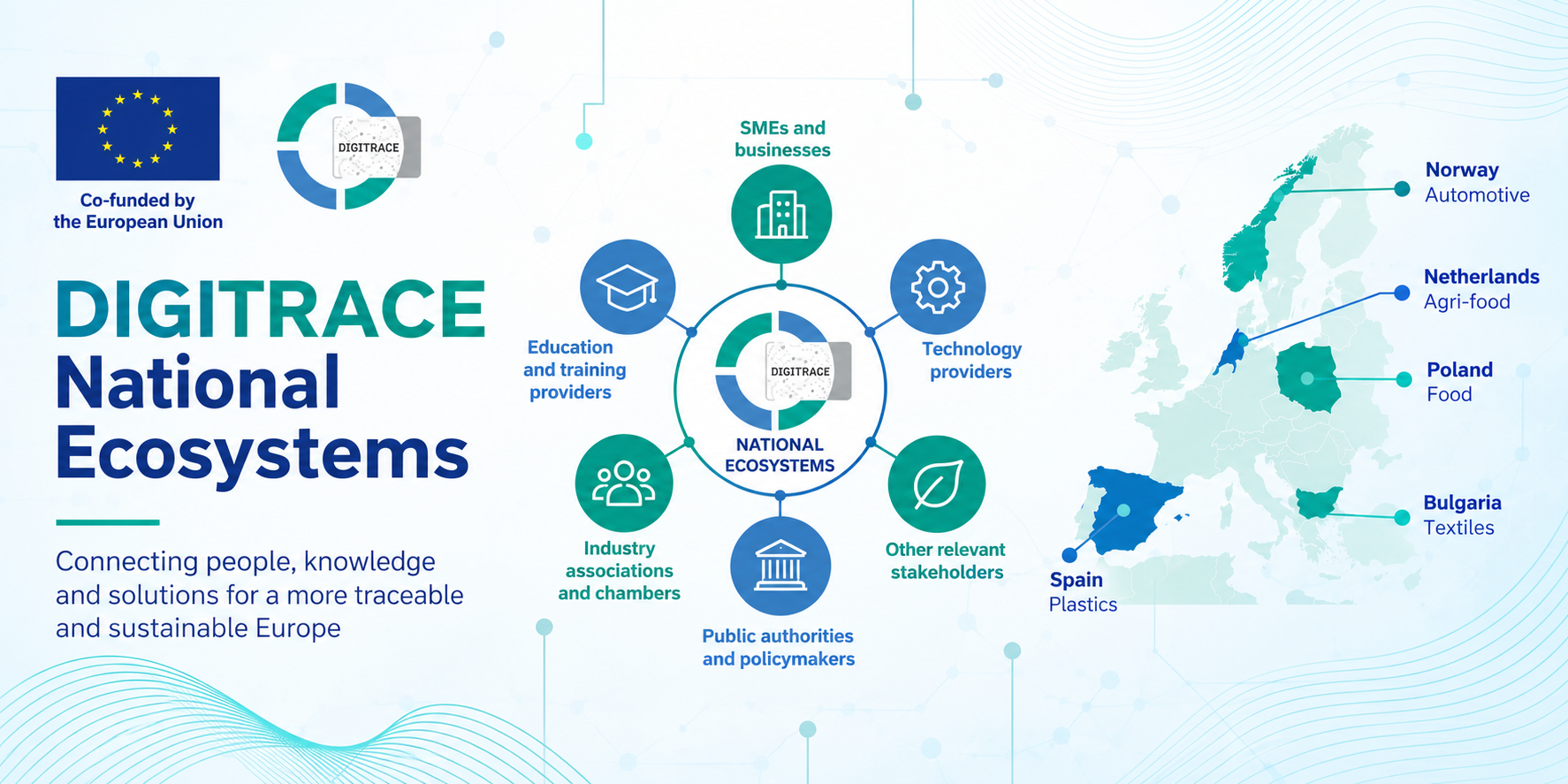
To help SMEs prepare for this transition, the European Erasmus+ project DIGITRACE - Digital Traceability Skills for Competitive and Sustainable Ecosystems is establishing National Ecosystems in its five participating countries: Bulgaria, Spain, the Netherlands, Norway and Poland.
We invite companies, industry organisations, education and training providers, technology providers, public institutions and other relevant stakeholders to join their National DIGITRACE Ecosystem and contribute their perspectives, experience and needs.
What are the DIGITRACE National Ecosystems?
The National Ecosystems are collaborative reference networks bringing together a diverse mix of SMEs and other businesses, Higher Education Institutions (HEIs), Vocational Education and Training (VET) providers, industry associations and chambers, technology providers, policymakers and other relevant stakeholders.
They will provide a space for participants to exchange knowledge and practical experience, discuss challenges related to DPP implementation and help ensure that the solutions developed by DIGITRACE reflect real-world industry and SME needs.
Each participating country will establish its own ecosystem, adapted to its national context and DIGITRACE target sector. Together, the five ecosystems will also support knowledge exchange and cooperation at European level.
Your experience can shape DIGITRACE solutions
A central role of ecosystem members will be to provide practical insights and feedback throughout the project.
By sharing their needs, challenges and experience, participating organisations will help DIGITRACE develop and validate relevant, high-quality training, practical guidance and digital tools that can support SMEs in preparing for the Digital Product Passport.
This two-way exchange will also help identify common barriers, skills gaps and opportunities that can feed into evidence-based recommendations for policy and SME support.
What are the benefits of joining?
Participation in the DIGITRACE National Ecosystems is voluntary and free of charge.
Members will have opportunities to contribute to the development of project solutions while gaining early access to DIGITRACE results and the Knowledge Hub, including training resources, sector-specific guidance and practical digital traceability tools.
Participation will also provide opportunities to exchange good practices, develop new connections with businesses, education providers, technology experts and institutions, explore work-based learning partnerships, and increase organisational visibility through DIGITRACE activities at national and European level.
What is the commitment?
We recognise that participants' time is valuable and aim to keep engagement focused and productive.
The main commitment is to participate in at least two National Ecosystem meetings per year during 2026-2028, where members will be invited to share their perspectives, provide feedback and contribute to discussions around project developments and DPP-related challenges.
Additional opportunities to contribute to project activities, training validation, knowledge exchange and dissemination will be offered according to participants' interests and expertise.
DIGITRACE National Ecosystem Charter
Participation in each National Ecosystem is guided by the DIGITRACE National Ecosystem Charter, which sets out the purpose of the network, the roles of its members and the principles for collaboration. By joining, members are invited to participate in approximately two meetings per year from 2026 to 2028, alongside companies, industry organisations, education and training providers, technology experts, public authorities and other relevant stakeholders from their country. Members contribute their perspectives, knowledge and practical experience, while gaining access to project information, developments and resources related to Digital Product Passports, digital traceability and sustainability.
The Charter also outlines how members can contribute to feedback and knowledge exchange, support the practical relevance of DIGITRACE results and help build a collaborative community that can continue beyond the project.